02 Envoy shudders off the line

filthyfingers

Lifetime VIP Donor
Member
Joined
Apr 7, 2012
Posts
107
Wife’s 2002 Envoy with 150k just started shuddering off the line then smooths out but still has a slight vibration. Not sure if this is a drivetrain or engine problem. We are the original owners and have not experienced anything like this before. From a dead stop as soon I start rolling the vibration is enough to visibly vibrate the driver side mirror. I don’t feel it in the steering wheel. Shifting seems smooth and the problem quiets down at higher speed but is still noticeable. The engine doesn’t sound right. I checked engine oil and transmission fluid - both ok. No CEL. In park and revving the engine everything sounds normal. I’ve never wished for a CEL before…
Any help would be greatly appreciated thanks.
 
  • Wow
Reactions: movietvet
I would be checking the motor and transmission mounts.
 
Have you done a fluid and filter change? What's the fluid condition? Sometimes just this could change the tranny behaviour.
 
Transmission fluid looks fine on the dipstick but hasn’t had a filter change in years. I’ll look into that.
Thanks Mooseman.
 
  • Like
Reactions: movietvet
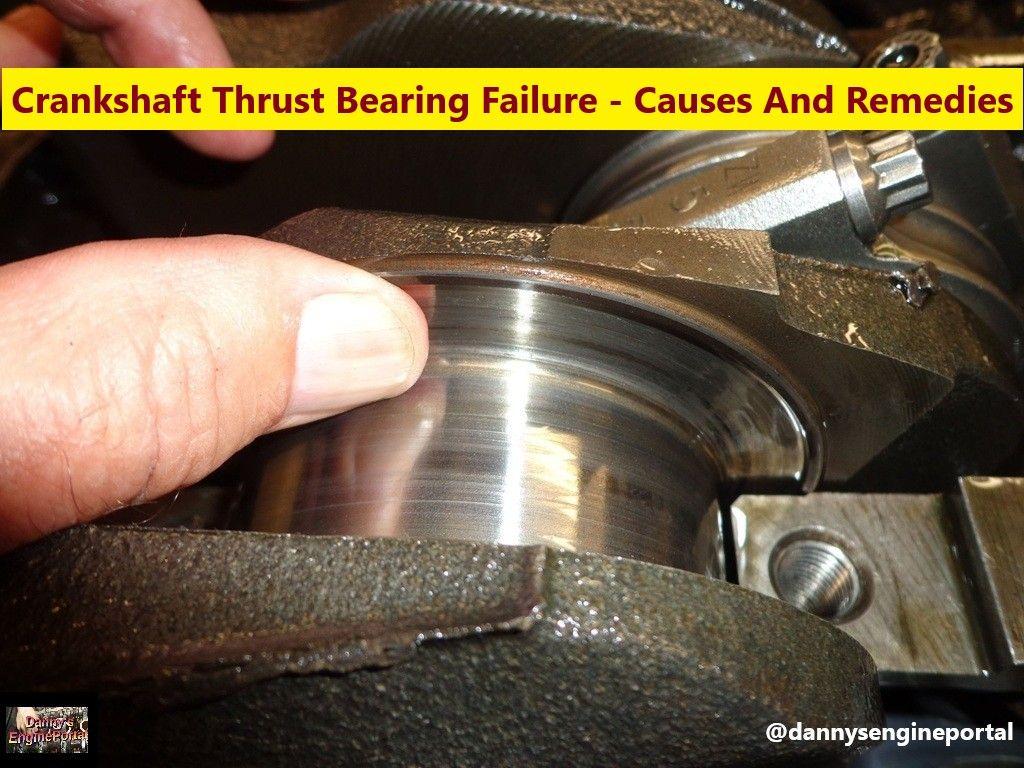
It's "Early Days" in terms of your engine approaching the limits of what constitutes "High Mileage" for the redoubtable GM 4.2L Vortec LL8 Engine. Nonetheless... Shuddering in transitions between low-idle RPM and Torque Demands placed upon the 4L60E A4 Low Gearing and the Torque Converter (which can ALSO be out of get out of balance and shake and shudder) CAN be dramatically affected by the Breakdown or complete loss of the Mains Thrust Bearing in the #5 Cylinder Position allowing the Crankshaft to shudder while hunting fore and aft until the torque demand and RPM settle out once the vehicle's inertia is overcome from a stand-still over to a steadily moving condition. The PXXXX Codes present can range from P0014-P0017 and a rare P0345 as also being symptomatic of this failure:

49746088962_6748d2b3c7_c.jpg

41590373190_c73e0c9157_c.jpg

The least invasive method for determining the possible involvement of the Thrust Bearing wear (or total failure of the side plates) is to take an Oil Sample from the present oil in the crankcase and send it off to Blackstone Laboratories for Oil Analysis and look for High Concentrations of Aluminum and Silica in the sample.

Send it HERE:


The GM OEM Mains, Thrust and Con-Rod Bearings are made of an Alloy of Aluminum with Silica added for toughness and durability without making the surface impenetrable from any invading foreign matter that might by-pass a clogged Oil Filter and be carried into the Oil Galleries to the Main Bearings at up to 65 PSI and potentially score or damage the radial crankshaft journal surfaces.

This will be Money Well Spent to know for sure about this otherwise Pending Catastrophic Engine Failure that might rear its ugly head with irreconcilable differences developing in between the between DOHC timing and any Crankshaft mis-alignment or disturbances... and you won't have to mechanically tear into the Engine in order to find out the Truth of this Theory.

A secondary issue may evolve over time from this engine developing a Cracked Flex-Plate Mounting Bolt Flange (circumferential cracking around the Bolts) and wind up making One Hell of a Racket (Loud Ticking and Knocking near the Bell Housing) should any Bad (Gel-Filled) Motor Mounts invite this issue as well as per @movietvet 's observations above.

For more information of this Topic:

 
Last edited:
  • Like
Reactions: movietvet
@mrrsm, was unaware of the #5 mains problems but I answered the way I did because no noises were complained about. I have heard of and seen one time, when in shops years ago, the flexplate cracking but seems that noises always accompanied the complaints.
 
  • Like
Reactions: mrrsm
There is a specific GM TSB covering the catastrophic failure and loss of the #5 Mains Thrust Bearing in the LL8 that eventually gets torn to shreds and re-distributed within the Oil Galleries right at the Main Bearing Oiling Holes...in essence... it can mean... "Bye-Bye Motor". The TSB insists that Engine Replacement is the only solution.

A better understanding of just how dynamic the actions are between the Mains Thrust Bearing and the forces imparted by a "Ballooning Torque Converter"... especially in Towing Applications and having Clogged secondary Transmission Oil Coolers goes a long way in explaining how this phenomena of Thrust Bearing Wear and Failures can develop:


Many Manufacturers of Flex-Plates include a separate Color Warning Label advising for "The Mandatory Replacement of ALL Motor and Transmission Mounts" prior to the installation of their products... or it VOIDS their Flex-Plate Warranties.

So your admonitions and warnings ...are "Spot On" because the Fore and Aft stresses that are ALWAYS present during the rise and fall of RPM and Torque are especially felt longitudinally across the full length of the exceptionally LONG Crankshaft inside the 4.2L Vortec Engine.

That Poor Crank is caught in between the constantly moving and adjusting Torque Converter and its Bolt On Flex Plate in the rear... and the Heavy Duty Harmonic Balancer at the front trying to dumb down those powerful forces... and meanwhile... the #5 Thrust Bearing is situated in between trying to absorb the force and motion happening and thus... mitigate the differences in between the two.
 
Last edited:
  • Like
Reactions: movietvet
Here is the Full Monty Write up with extensive imagery for any Engine Builders having the interest:

 
No CEL. In park and revving the engine everything sounds normal. I’ve never wished for a CEL before…
Just a friendly reminder... The so-called "Check Engine Light" (CEL) is there only for EMISSION-related Diagnostic Trouble Codes (DTCs).

I'd be checking for NON-emission-related DTCs, with software (either built into the scantool or used with a smartphone/tablet/laptop in conjunction with a simple, inexpensive OBD2 hardware "dongle") that's known to be capable enough to issue the requisite commands to the vehicle.

Regardless of whether your problem is an engine issue or a transmission issue, a DTC might help pinpoint the diagnosis. For the record, I can't think of a single case of a transmission problem that would trigger a CEL. And any NON-emission-related engine problems won't trigger the CEL either.

Bottom Line: IMHO, it's almost always wise to check for DTCs with a capable scantool setup before getting too deeply into any diagnosis.
 
  • Like
Reactions: movietvet
Transmission fluid looks fine on the dipstick but hasn’t had a filter change in years. I’ll look into that.
Thanks Mooseman.
before you get going into tearing too much apart (although some of the regular maintenance items is wise... ie. fluids, filter, etc), take a look at the back end... specifically the rear control arm links on each side at the rear wheels. They may have fractured / rusted or otherwise fell apart. When that happens, you may feel significant "off the start" issues as the drive line has problems with staying "aligned" when torque is applied. From my experience, one link gone will only result is very slight vibration in the vehicle but when the second breaks, then things begin to happen... :-)
 
Last edited:
Regardless of whether your problem is an engine issue or a transmission issue, a DTC might help pinpoint the diagnosis. For the record, I can't think of a single case of a transmission problem that would trigger a CEL. And any NON-emission-related engine problems won't trigger the CEL either.
That is not quite true. There are lots of transmission related codes.
That being said, not all transmission problems will trigger a code.

And I'm pretty sure that are some non-emissions related codes that will trigger a CEL. The EV cooling fan codes come to mind.

It's "Early Days" in terms of your engine approaching the limits of what constitutes "High Mileage" for the redoubtable GM 4.2L Vortec LL8 Engine. Nonetheless... Shuddering in transitions between low-idle RPM and Torque Demands placed upon the 4L60E A4 Low Gearing and the Torque Converter (which can ALSO be out of get out of balance and shake and shudder) CAN be dramatically affected by the Breakdown or complete loss of the Mains Thrust Bearing in the #5 Cylinder Position
I highly doubt that would be the issue on such a high mileage engine. Just look at the current issues with the 6.2L gas and 3.0L diesels where they are eating their thrust bearings and grenading in short order. At 150k miles, it would have manifested itself by now. And as you indicated, thrust bearing issues on this engine were associated with a couple of codes that would have set a CEL.

Lets look at the simple stuff first.

before you get going into tear too much apart (although some of the regular maintenance items is wise... ie. fluids, filter, etc), take a look at the back end...
That reminds me of another thing that I had. The driveshaft slip yoke that goes into the tranny or transfer case. I had an issue where it would cause a clunk/bump when coming to a stop. The fix for this was to add some grease to the splines inside. And while you're there, check the U-joints.
 
  • Like
Reactions: movietvet
That is not quite true. There are lots of transmission related codes.
I think I may have been misunderstood. I'm certainly not saying that there are no transmission-related DTCs!

I'm simply trying to dispel the all-too-common misunderstanding that "code present" equates to "CEL illuminated".

Having said that, after some research, I see that for the 2002 Envoy, several (a surprising number, in fact, IMHO) of the transmission DTCs will set the "MIL" (the proper name for "CEL"). So, on this vehicle (and probably many others, I suspect), GM seems to be using the "CEL" to indicate that a transmission-related DTC is present. (Some other vehicles don't do that. I suspect that I may have been thinking too heavily of Ford rather than GM when I posted earlier.)

And I completely mis-spoke when I wrote this:
And any NON-emission-related engine problems won't trigger the CEL either.
I meant to say that "NON-emission-related engine problems won't necessarily trigger the CEL". P0128 ("Coolant Temperature Below Thermostat Regulating Temperature") is a typical example.

Again, my overriding point is that people should not assume that "no CEL" = "no codes". I check for DTCs at least once a month on all vehicles I have access to, regardless of whether any warning lights are present on the dashboard. Some might be surprised at how many things turn up that way, with no other indications of an issue.

I still stand by the "Bottom Line" part of that earlier post. But I apologize to all for being both imprecise and misleading in my earlier post.
 
  • Like
Reactions: movietvet

Forum Statistics

Threads
24,241
Posts
648,334
Members
20,676
Latest member
rkd691

Members Online