Evap Large Leak Code

GreenBravada

Member
Joined
Mar 21, 2025
Posts
70
Location
Lorain, OH
I guess most of you recognize these purge/vent/valve/solenoids.
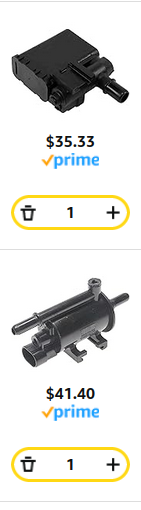
1745002510693.png

I have a new gas cap and I generally find pinched or broken hoses on other cars when I get this P0455 code. Is there any way to test whether or not these things are functioning either by "feel" or through the OBDII data? I'm not sure when the canister is supposed to get purged or what the sequence is for that to take place. I'm trying not to throw new parts at this unnecessarily.

Just looking for an "off the top of your head" response at this point. Probably get to dig into it on Sunday.
 
As far as the vent valve goes it is normally open.

The only time it is powered close is during the brief time when all the various prerequisite conditions are met and the PCM decides to perform a leak test.

The purge valve should normally be closed except when the PCM has determined conditions are proper to purge the canister with a modulated flow of air into the intake manifold.

It is possible to monitor the fuel tank pressure via OBD2 data. This is generally not going to help much as far locating a leak though.

I have never had occasion to test a purge valve for a leak.

I have removed my vent valve and tested that for a vacuum leak using a MityVac hand vacuum pump whilst powering the valve closed.
 
If you have capable scanner or maybe if @TJBaker57 is able to replicate the tests using an Elm327 adapter, here's an excellent video from SMA on how to diagnose this code:

 
I just solved my Code P0440 Evap code for my 2003 Envoy i6. It started a few months ago and I replaced (over time) every major component in the following sequence and the results: New fuel cap. (did not fix the issue) Fuel pressure regulator and the vapor canister fuel purge valve (did not fix problem). Fuel inlet pipe from the outer filler opening to the tank filler tube (did not fix the problem) Tank inlet filler tube, tank pressure sensor and the Vapor Canister Purge Solenoid on the side of the tank (fixed the problem). I think the problem was both the metal filler tube AND the pressure sensor on the tank.

Your mileage may vary here. I found a much better way to replace the vapor canister fuel purge valve so that's a bonus. Remove the rear electrical connector, pull the tube where it connects at the upper intake side (this give you an idea how the one on the valve needs to be removed without damage), pull some of slack now present in the tube and feed it down as you pull the purge valve up. Keep at it and you can pull the purge valve way up and this gives you complete access to the valve. Easier now!
 
Last edited:
found a much better way to replace the vapor canister fuel purge valve so that's a bonus. Remove the rear electrical connector, pull the tube where it connects at the intake (this give you an idea how the one on the valve needs to be removed without damage), pull some of slack now present in the tube and feed it down as you pull the purge valve up. Keep at it and you can pull the purge valve way up and this gives you complete access to the valve. Easier now!


Purge or Vent? AFAIK Purge valve and solenoid are at the engine, Vent valve and solenoid are at/near the fuel tank.

I may be confused here.
 

Forum Statistics

Threads
24,254
Posts
648,442
Members
20,696
Latest member
eachargis

Members Online