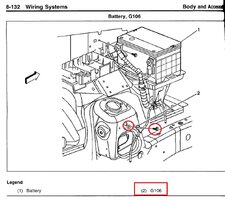
G106 alternative location

Elizabetty

Member
Joined
Dec 2, 2022
Posts
191
Location
Wisconsin
Hello. The ground that I believe to be g106 is highly corroded and I believe when going to fix this, I am not going to be able to find a clean surface to attach to. The entire area is very rusty. I was informed that where it looks like there is a crimp or connection of two cables where the corrosion is at the bolt, it runs after g106 to the block. I suppose it's possible under all of the green corrosion there aren't two wires crimped and it simply one wire bolted here and then continues on, but I was giving the impression there is a connection from battery to g106 and then a second connection that runs to the block.

When I attempt to fix this, if I am correct and I'm not able to get a rust free surface, what would be an alternative spot to ground to? I understand I can use various bolts already in existence, but it's my understanding I want the shortest path possible. Plus there's not much without thick rust to work with.

The plan I was given was to either run all new cable, or, splice in a section of cable that would be either soldered or crimped with heat shrink. Editing this to add that I think I could buy a new battery cable that would run directly from the terminal to my new ground and then hopefully have enough length to connect to where it needs to then run to the block. I don't understand why it was suggested I would splice in between g106 and the battery when it's just a short distance unless it's because of cost.

If I were to cut the cable between the battery and g106, I would need to then attach to the chassis or frame and of course then make sure I have cable connected from that spot and spliced into the one coming off the block.

I am unsure how to determine what gauge battery cable I need and how to go about finding a good ground point in this area when everything seems very thickly covered in rust where the original g106 is. It is my understanding the ground at the block is fine but that midpoint g106 is a problem.
 

Attachments
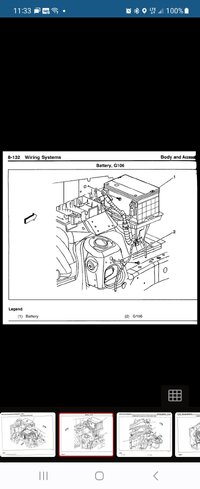
  • Screenshot_20230202_113310_Chrome.jpg
    Screenshot_20230202_113310_Chrome.jpg
    155.7 KB · Views: 23
  • Screenshot_20230202_114006_Video Player.jpg
    Screenshot_20230202_114006_Video Player.jpg
    282.1 KB · Views: 26
Last edited:
I cant swear to it, but I think this is the ground cable you are looking for.. @Mooseman or @mrrsm should be able to confirm.


That said, you can attach that to any existing bolt/nut location at the frame... I will have to take a look at mine to see what other options there may be. I am fairly certain there are quite a few options thou..

You could run it forward to the bumper frame horn, and get the same result.
 
I cant swear to it, but I think this is the ground cable you are looking for.. @Mooseman or @mrrsm should be able to confirm.


That said, you can attach that to any existing bolt/nut location at the frame... I will have to take a look at mine to see what other options there may be. I am fairly certain there are quite a few options thou..

You could run it forward to the bumper frame horn, and get the same result.

Trying to shop locally as opposed to ordering online and waiting and I found this which I'm thinking looks a lot like my situation. If I'm understanding this picture as opposed to the one you supplied, I'm thinking that midsection where the bolts would go through is where I have the corrosion at g106 and this piece would solve it but I'm not sure I'd be able to reach in far enough to access g110 where I believe the final end connects to the block.

I'm not 100% sure I'm understanding the diagrams I've been using correctly or this product that I'm looking at correctly but it does seem to match what I'm looking at in my vehicle.

If I can't access g110 myself, then I'm going to have to take this in and pay someone to do it which is frustrating after receiving the quote today. Additionally, I'm finding it impossible to figure out what size that bolt is in case I do successfully remove it and clean the area but need to replace it with install. I was hoping to have all the parts here at once but I can't seem to find what size that bolt is.

I think your link has me on the right track, but it's a different year so possibly a different setup? I also found an AC Delco one on RockAuto but it doesn't look like mine versus the NAPA part one looking very similar.
 
As for the bolt, GM is pretty notorious for using nearly the same bolt, thread, and pitch, across an entire manufacture. If that applies to this bolt, I dont know.. But its GM, so likely.

As for the "local cable", I only see one problem, that second, shorter, leg, doesnt appear to have the length needed to make it to the body ground. Everything else may be good for the application.
 
G106 is the main ground from the battery to the body/frame. If you remove it, you should be able to clean it down to bare metal. It's the strut tower and I can't imagine it being so rusty that you can't find good metal there. A wire brush or even coarse sandpaper should be able to clean it. Don't forget to clean the eyelet and bolt.
 
G106 is the main ground from the battery to the body/frame. If you remove it, you should be able to clean it down to bare metal. It's the strut tower and I can't imagine it being so rusty that you can't find good metal there. A wire brush or even coarse sandpaper should be able to clean it. Don't forget to clean the eyelet and bolt.
That's kind of my problem. It's pretty much solid rust in there from a visual standpoint. I will be working on it tomorrow but my concern is that I'm not going to be able to connect there. With all of the other ground chasing and fixes I have done, I didn't even look at the main one from the battery because two different auto shops did and told me everything looked good. So I focused on all of the other grounds like under the driver side door and in the rear underneath and under the radiator etc because they didn't have any interest in checking those all willy-nillies so I at least had them check the main one from the battery which was apparently a waste of money since I found this on my own. It was only two nights ago that I was moving the wiring harnesses around and happened to see it and got concerned I don't have a good place to connect. I'm certainly going to try, but I can assure you that it's rust city in there. :(
 
As a final test you can check for a voltage drop across the connection with the engine running and lights/fan/etc tuned on. With a multi-meter set to Volts DC, touch one lead where the wire goes into the eyelet and the other on bare metal just adjacent to, but not touching, where the eyelet attaches to body ground. A resistance across the connection will translate to a voltage when current is passing through the connection; ideally should be 0V.
 
Found this video that's pretty informative on how to look for ground issues. I especially liked the multimeter method and see if there's a voltage drop compared to the battery. Also liked the jumper cable method.

 
The suggestions for performing a "Voltage Drop Test" urged on by @azswiss and @Mooseman are particularly important when diagnosing electrical problems on the Aging GMT360s ...especially those that look like they've been recovered by Jacques Cousteau from the bottom of the Sargasso Sea after centuries of Caked On Rust Flaking and Barnacle Growth. Such condition are definitely NOT conducive to The Flow of Electrons.

Please spend some time "In Class" with the Students at Rosedale College where Paul "Scanner" Danner taught hundreds of aspiring Mechanics in 'The Divine Art of Automotive Drive-Ability Diagnostics". THIS Lesson (...I can recommend that you Download, Save such videos in your "Mechanic's Multi-Media Library" Folder) covers the areas concerned with 'Multi-Meter Basics of Electricity' in Automotive Applications. The "Voltage Drop Test" sequence he covers so well within these White Board Explanations ...is Sweet!


It follows on that IF you are going to conduct a Voltage Drop Test and you are SOLO... You will need to get one of THESE Auto Remote Starter Switches to be able to activate the Starter Motor while performing a measurement of the "Positive to Positive" Voltage Potential DIFFERENCE on the B+ Power Wire in between the (B+) Positive Battery Terminal and the other end of the (B+) Wire at the Starter Motor Connection using a Digital Multi-Meter (DMM) or a DVOM (Digital Volt Ohm Meter). If you HAVE THIS TOOL... The Ignition Key can remain in the OFF Position as it is unnecessary to Try to Start The Motor when the Remote Switch in your hand serves this purpose. :>)

( Or... For a Voltage Drop Test on a Ground Circuit ... Use DMM in between the (B-) Negative Battery Terminal and make a connection with the other end of the Negative Battery Cable at either the Body Frame or the Engine Block for a "Negative to Negative" Test.). Bad Grounds will induce WEIRD Problems while B+ Electricity seeks to follow the Path of Least Resistance and tries to find a Ground Path right back to the Battery Negative Terminal ...by ANY other Grounds in the Vehicle!


These Hand Switches are readily available on Amazon via some Choice Selections:


But... I prefer using THIS Particular One:


71ZbhxyubXL._AC_SL1500_.jpg
 
Last edited:
  • Love
Reactions: Randomsunshine
This another EXCELLENT Visual Step-By-Step for "How To Test The Starting Circuit" along with "How To perform a Voltage Drop Test" with ALL the Parts & Pieces... Very Nicely "Bread-Boarded" Below: :>)


The KEY Things to Remember are THESE IDEAS:

(1) A Volt Meter Does NOT Measure Voltage.
(2) A Volt Meter Measures the DIFFERENCE IN ELECTRICAL POTENTIAL in a Circuit.
(3) Voltage Drop Tests are either POSITIVE TO POSITIVE or NEGATIVE TO NEGATIVE.
(4) Voltage Drop Tests MUST be done when CURRENT IS FLOWING IN A CIRCUIT.
(5) You WILL Need: A DMM, A Lighted Probe, A Remote Starter Switch ...and PATIENCE.
 
Last edited:
Hello. The ground that I believe to be g106 is highly corroded and I believe when going to fix this, I am not going to be able to find a clean surface to attach to. The entire area is very rusty. I was informed that where it looks like there is a crimp or connection of two cables where the corrosion is at the bolt, it runs after g106 to the block. I suppose it's possible under all of the green corrosion there aren't two wires crimped and it simply one wire bolted here and then continues on, but I was giving the impression there is a connection from battery to g106 and then a second connection that runs to the block.

When I attempt to fix this, if I am correct and I'm not able to get a rust free surface, what would be an alternative spot to ground to? I understand I can use various bolts already in existence, but it's my understanding I want the shortest path possible. Plus there's not much without thick rust to work with.

The plan I was given was to either run all new cable, or, splice in a section of cable that would be either soldered or crimped with heat shrink. Editing this to add that I think I could buy a new battery cable that would run directly from the terminal to my new ground and then hopefully have enough length to connect to where it needs to then run to the block. I don't understand why it was suggested I would splice in between g106 and the battery when it's just a short distance unless it's because of cost.

If I were to cut the cable between the battery and g106, I would need to then attach to the chassis or frame and of course then make sure I have cable connected from that spot and spliced into the one coming off the block.

I am unsure how to determine what gauge battery cable I need and how to go about finding a good ground point in this area when everything seems very thickly covered in rust where the original g106 is. It is my understanding the ground at the block is fine but that midpoint g106 is a problem.
HI, https://gmtnation.com/forums/members/elizabetty.31818/ @Elizabetty
I'm having an issue with the same ground, my frame is not so rusted but the original frame point is painted and as you know right above the tire spray. I believe the ground issue is what is causing the reoccurring C0455 which continues disable my stabilitrak. So with all that, where did you end up rerouting your G106 midpoint? Did it solve your problem? Supposedly this is a common issue with this year making model but this is about the only thread I can find that talks about the link going back to the G106 and relocating it. Thank you in advance for any help!
 
If you're asking @Elizabetty , she hasn't been on here in over 2 years so might not get a reply. Hopefully someone else has an idea.
 
  • Love
Reactions: Randomsunshine
This Response PDF is compiled from a DuckDuckGo "Search Assist" involving your specific RFH (Request For Help) that refers the Reader right back here to "gmtnation.com"

img019.jpg
 

Attachments

I have never tried moving a ground point... but why don't you try. You probably don't have to move your ground point.... maybe. As a test, make up a cable (8-10ga) and "ring crimp connectors" on both end. Connect one end to the existing ground point and wire (ie. bolt them together there). Take the other end to some accessible ground point area (guess... fire wall maybe) and bolt that end there. See if your issue goes away. Further, try measuring the resistance between the existing point and the battery negative... what does it say. Do this before and after trying the "pigtail ground cable" that I described.
 
  • Love
Reactions: Randomsunshine
I believe the ground issue is what is causing the reoccurring C0455 which continues disable my stabilitrak.
If this is the ONLY code you're getting (i.e. no ABS codes), then your Steering Wheel Position Sensor is probably defective. It's a common failure part and we have lots of threads here about it. It's the only part that serves only the Stabilitrak system.


If you're also getting an ABS code, the THAT is the source of the Stabilitrak error as that is essentially the heart of the system. Stabilitrak is just an extension of it.
 
If this is the ONLY code you're getting (i.e. no ABS codes), then your Steering Wheel Position Sensor is probably defective. It's a common failure part and we have lots of threads here about it. It's the only part that serves only the Stabilitrak system.


If you're also getting an ABS code, the THAT is the source of the Stabilitrak error as that is essentially the heart of the system. Stabilitrak is just an extension of it.
@Mooseman Thank you for you input and resources! I'll check those threads out.

I only get the C0045 code no matter what lights come on, that being service four-wheel-drive or service stabilitrak.

I bought a steering wheel angle sensor and I was about to put it in, but then I did started reading a lot of forums. There’s a lot of people who replaced the sensor, multiple times and still have the problem, so that’s what sent me looking for a ground fault, which I did find in my G106. It was wildly corroded on the strap to frame connection point and the copper wire was visually corroded.

After cleaning up the connection, the error code went away and traction control kicked in for the first time in seven years, but then the next night the problem came back, so I decided to sand the paint off of the frame connection, cause why in the world would they paint a ground connection!? The light came on only one time right after I did the sanding, only when I put the car in reverse , had the code read, same findings.

Now ive been driving all day long over 100 miles and the light has not come back and Stabilitrak kicked in all day, but it was also warmer out today, and I question how the temp plays into it this problem. That data led me to continue to believe I have a faulty ground cord. Everything I read says if your sensor isn’t getting consistent readings, a new sensor won’t fix the problem and you can’t properly do the steering wheel relearn.

I’m not opposed to putting in the sensor I bought. I just wanted to make sure it’s getting good consistant Electrical signals first. I don’t wanna pay to have this steering relearn calibration multiple times. I appreciate your input.

* The pictures are before I sanded the frame down to bare metal.
 

Attachments

  • IMG_0747.jpeg
    IMG_0747.jpeg
    401.9 KB · Views: 5
  • IMG_0751.jpeg
    IMG_0751.jpeg
    303.7 KB · Views: 5
Last edited:
I have never tried moving a ground point... but why don't you try. You probably don't have to move your ground point.... maybe. As a test, make up a cable (8-10ga) and "ring crimp connectors" on both end. Connect one end to the existing ground point and wire (ie. bolt them together there). Take the other end to some accessible ground point area (guess... fire wall maybe) and bolt that end there. See if your issue goes away. Further, try measuring the resistance between the existing point and the battery negative... what does it say. Do this before and after trying the "pigtail ground cable" that I described.
 
@Mooseman Thank you for you input and resources! I'll check those threads out.

I only get the C0045 code no matter what lights come on, that being service four-wheel-drive or service stabilitrak.

I bought a steering wheel angle sensor and I was about to put it in, but then I did started reading a lot of forums. There’s a lot of people who replaced the sensor, multiple times and still have the problem, so that’s what sent me looking for a ground fault, which I did find in my G106. It was wildly corroded on the strap to frame connection point and the copper wire was visually corroded.

After cleaning up the connection, the error code went away and traction control kicked in for the first time in seven years, but then the next night the problem came back, so I decided to sand the paint off of the frame connection, cause why in the world would they paint a ground connection!? The light came on only one time right after I did the sanding, only when I put the car in reverse , had the code read, same findings.

Now ive been driving all day long over 100 miles and the light has not come back and Stabilitrak kicked in all day, but it was also warmer out today, and I question how the temp plays into it this problem. That data led me to continue to believe I have a faulty ground cord. Everything I read says if your sensor isn’t getting consistent readings, a new sensor won’t fix the problem and you can’t properly do the steering wheel relearn.

I’m not opposed to putting in the sensor I bought. I just wanted to make sure it’s getting good consistant Electrical signals first. I don’t wanna pay to have this steering relearn calibration multiple times. I appreciate your input.

* The pictures are before I sanded the frame down to bare metal.


While you are cleaning grounds.... It may be of interest that according to wiring diagrams the steering wheel sensor is grounded at G102. That ground is near the underhood fuseblock on the inner fender.

That said, G102 also grounds a number of other notable circuits such as the instrument cluster and one of the grounds to the OBDII port. So if there were significant issues with G102 I suspect it would affect the cluster operation.
 
To "Kill Two Birds with One Stone"...Using a Three Word String like "GMTNATION GROUNDS REALISM" Using the DuckDuckGo Search Engine... Will Yield THESE Possibilities when trying to Search the GMT Nation Forum(s):

 
C0045 code means there's a malfunction in the Left Rear Wheel Speed Sensor Circuit


So either the sensor is bad or its circuit/wiring has an issue. You're probably also getting an ABS light as well with this code, which is why the Stabilitrak light is also on.
 

Forum Statistics

Threads
24,253
Posts
648,441
Members
20,695
Latest member
aro_hero

Members Online