HVAC actuator repairs

dhanger

Member
Joined
Apr 8, 2025
Posts
109
Location
Arizona
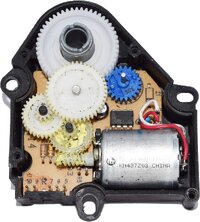
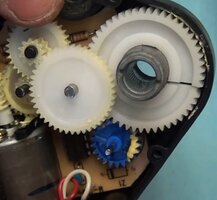
Recently I noticed that the passenger side temp mix door was stuck on hot. As I investigated I found that 3 of the 5 actuators were not working any more. I was aware of the common problem of the main drive gear in the actuator cracking and spinning on the hub so it will never go through a proper re-calibration any more. Unfortunately one of the broken ones was the recirculation door at the top so I knew I was in for a rough time getting the dash apart, and it was all they said it would be:stars:, along with several aged plastic tabs that broke along the way and will need some minor repairs on assembly. So I ended up removing all 5 actuators and came up with a repair solution that only cost a few pennies and my time, which would be the same no matter what repair I came up with. I know you can buy a replacement gear from Amazon for about 15 dollars but that would be $75 for the lot, and replacing the whole actuator would cost even more than that, especially if I wanted to replace all 5 for my trouble. Instead I bought a set of roll pins (https://www.amazon.com/dp/B0DFLHP2HB/?tag=gmtnation-20) and used a 5/64 x 1" for each gear.
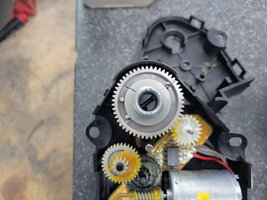
20260301_121326.jpg

After removing the cracked gear/hub from the assembly, I removed the gear from the hub and then rotated it so that the crack would end up about halfway between 9 and 12 o'clock when the gear is in its midrange position. In this position the crack would never come into contact with either the pot. gear or the idler so no worries of skipping or jumping or damage to the other gears. I then drilled the hole for the roll pin roughly 90 degrees from the crack (roughly being the key word here LOL). The hole should be about 1/8" in from the front edge of the gear; in that location the hole doesn't contact the narrow faced pot. gear and the idler gear has a wide enough face that the hole is irrelevant. Drill all the way through so the pin can be punched out if needed. Try to make sure the drill is lined up as close to center as possible--if it's too far off center then when it breaks through the center and starts into the other side of the metal hub it could pull the drill off center and cause problems getting the roll pin in. Ideally should use a drill press for this, trying to do it by hand probably will go badly. Then drive the pin all the way through evenly. When the pin is in the 1/8" location off the front edge there is no interference with anything as the door input shaft only goes part way in the other end.

20260301_120755.jpg

Final assembly: rotate the pot. gear so that the 2 raised round bosses are horizontal and the lettering is at the top. Then work the repaired gear in so that the gear is midrange when meshed with the pot. gear (slots in hub end are vertically aligned). Then replace the idler gear. After this check the resistance between pin 7-9 and pin 9-10; they should be measuring roughly the same when the pot. gear is aligned correctly, about 4.5K ohm, if not then rotate the drive gear one tooth or whatever is needed. One exception to this is the recirculation door which does not use a pot. for positioning, just goes from end to end as needed so no gear alignment is needed.

After re-installing the actuators without connecting them, I re-attached the battery and then plugged the connectors in one at a time to verify that re-calibration goes through on each one. Perfect!

It took me about 6-7 hours to get to this point, tomorrow will be full dash re-assembly day. Bonus: I no longer have to be on pins and needles whenever I need to disconnect the battery any more, which is good because here in Arizona batteries only last 3-4 years in the heat so it's a regular thing.

At the tone the time will be: beer-thirty Mountain Time.
 
  • Like
Reactions: movietvet
  • Like
Reactions: movietvet
...and if things go -=Sideways=- and the Gear breaks half-in-two... Amazon has an inexpensive Kit as a Back-Up to this novel, clever tactic


View attachment 118859View attachment 118860View attachment 118861


Yeah, that's the gear I was talking about. It's a simpler solution for sure and possibly better in the long run, but I'm betting that once the gear cracks then the stress is relieved and not likely to crack or break again--only time will tell but with a 22 year old vehicle I suspect the repair will outlast the car. From all the research I did on this problem it seems that the only common fault is the cracked gear and nothing else in the assembly fails.


Nice fix! How does the alignment of the gears for you jive with what was previously known in this thread?

That photo is one I used as a starting point for understanding the relationship of the gear timing, If one aligns the gears this way there really isn't a need to check the resistance at the pins but it does confirm beyond a doubt that the alignment is correct and also confirms that the pot is in good working order.
 
  • Like
Reactions: Mooseman
Yeah, that's the gear I was talking about

I have had another gear lose a tooth. So while it is less common I would say it is possible that future troubles may arise with the other old gears.

Personally I wouldn't worry about it with actuators that are readily accessible. However, for actuators that require stripping out the whole dashboard I would give consideration to replacement of such actuators.

IMG_20190320_110125.jpg
 
  • Like
Reactions: Mooseman
So I ended up removing all 5 actuators and came up with a repair solution that only cost a few pennies and my time, which would be the same no matter what repair I came up with.
Very creative thinking... nice job!

Although it's not an option for everyone, for those who own (or have access to) a suitably capable 3D printer and some suitable filament (probably PET-G or ABS), one might consider "printing" that gear.

Having owned a 3D printer for about a year now, I've been printing (and, in some cases, designing) all sorts of useful things.

I took a look around on the Internet and found this 3D model, which seems to be the gear in question.

It's apparently applicable to a broad range of vehicles, including many GM models. It has 49 teeth. The inner hole is 14 mm (about 0.55 inches) in diameter. Outer diameter, measured from the outer edge of a tooth to the outer edge of the opposite tooth, is 35.665 mm (about 1.40 inches).

Just for fun, I loaded that 3D model in the "slicer". (A "slicer" is a piece of software that converts a 3D model into "G-code" -- a format that the 3D printer needs.) The slicer estimates the total filament cost to print something, with some variance based on print settings. In this case, a single gear, with the settings that I'd use, comes out at $0.12 (12 cents). "A bargain at twice the price!", as the old saying goes. :biggrin:

I have not personally tried this method for such a gear, but I certainly will if I ever find a broken actuator gear, especially if it's one that's relatively easily accessible. Clearly, given how many 3D models are out on the Internet for these various gears, others have taken this path, presumably with some measure of success.
 
  • Like
Reactions: Mooseman
Very creative thinking... nice job!

Although it's not an option for everyone, for those who own (or have access to) a suitably capable 3D printer and some suitable filament (probably PET-G or ABS), one might consider "printing" that gear.

Having owned a 3D printer for about a year now, I've been printing (and, in some cases, designing) all sorts of useful things.

I took a look around on the Internet and found this 3D model, which seems to be the gear in question.

It's apparently applicable to a broad range of vehicles, including many GM models. It has 49 teeth. The inner hole is 14 mm (about 0.55 inches) in diameter. Outer diameter, measured from the outer edge of a tooth to the outer edge of the opposite tooth, is 35.665 mm (about 1.40 inches).

Just for fun, I loaded that 3D model in the "slicer". (A "slicer" is a piece of software that converts a 3D model into "G-code" -- a format that the 3D printer needs.) The slicer estimates the total filament cost to print something, with some variance based on print settings. In this case, a single gear, with the settings that I'd use, comes out at $0.12 (12 cents). "A bargain at twice the price!", as the old saying goes. :biggrin:

I have not personally tried this method for such a gear, but I certainly will if I ever find a broken actuator gear, especially if it's one that's relatively easily accessible. Clearly, given how many 3D models are out on the Internet for these various gears, others have taken this path, presumably with some measure of success.

I checked that STL file and your numbers with respect to the file are correct, but that doesn't match the actual gear. I counted 51 teeth (twice!) and O.D. of 34.1mm (1.343"). 14mm I.D. is correct. As well, the author doesn't include the TB in the compatibility list, so you would have to look for another model.

Does your printer handle pretty high resolutions? Gear teeth are pretty small and would need to be high enough resolution to be smooth working. I've not gotten into 3d printers yet, if ever, which is kinda weird for me being a (retired) toolmaker with 45 years experience in the plastic injection molding industry. I have a small 3 axis CNC mill in the garage that I could use for it but I would have to acquire and configure a rotary axis, or go cheap and use a manual dividing head with a gear cutter.

If you can't find the same gear file I can reverse engineer it and re-create it in Solidworks for anyone interested, but I would be surprised if it's not out there somewhere already.
 
I checked that STL file and your numbers with respect to the file are correct, but that doesn't match the actual gear. I counted 51 teeth (twice!) and O.D. of 34.1mm (1.343"). 14mm I.D. is correct.
Very interesting! I wonder if those (small) discrepancies would prevent the 3D gear from actually working?

As well, the author doesn't include the TB in the compatibility list, so you would have to look for another model.
I compared various compatibility lists -- the 3D model's list (which, to be fair, I don't think was intended to be considered "complete") and a couple of actuators sold on Amazon that have an identical outward appearance to the ones being discussed here. Based on that, I really don't know how much to believe any compatibility list. There is certainly a lot of overlap.

I suppose the internal gearing of any given actuator could be diverse, as long as the external interface (the mounting, connector/pinout, and drive shaft that connects to the HVAC door) was consistent. Maybe that accounts for the discrepancy in the various final drive gears, but really, who knows? :confused:

If you can't find the same gear file I can reverse engineer it and re-create it in Solidworks for anyone interested, but I would be surprised if it's not out there somewhere already.
I don't actually own any GM vehicles, but sometimes work on them for others, so it's possible that I will be confronting this issue at some point and I like to stay 1 step ahead of the game. I have no doubt that your CAD skills exceed mine by a very large amount -- I'm still in the learning stage, to be sure. So I very much appreciate the offer! But if the time comes, I will probably try my hand at designing one. Heck, I might even do it for the learning experience, on some rainy afternoon.

Does your printer handle pretty high resolutions? Gear teeth are pretty small and would need to be high enough resolution to be smooth working.
My printer is using the original 0.4-mm nozzle. And since I haven't printed too many things requiring high resolution, I haven't bothered to try a narrower nozzle just yet. But some day, I'll try a 0.2-mm nozzle since many folks have done that with seemingly good results. I have experimented with varying the "layer height", but that's usually been to increase it (to speed up prints where resolution isn't important), not decrease it. But, like with CAD, I'm still in the 'learning and experimenting' phase there too.

I'm curious enough about all this that I might try printing a gear, even with my less-than-ideal nozzle, even in plain-ol' PLA filament, but with a lowered layer height, the next time I fire the ol' gal up to print. I can afford to waste 12 cents of plastic. :wink:
 
Very interesting! I wonder if those (small) discrepancies would prevent the 3D gear from actually working?

Highly unlikely that they would work together for various reasons, several parameters have to match for the gears to mesh properly. I won't bore you with the details but if you're interested I'd be happy to elaborate. I've worked with a lot of spur gearing over the years in my trade so I've accumulated a lot of knowledge. I've designed several molds with gear trains involved, including one for a deisel rig ABS module with 9 threaded ports that required a gear train on both halves of the mold for extracting the threaded cores to de-mold the part. Also a mold for an AR magazine with a custom built tool steel gear sector, I don't remember the size but if it were a full round gear it would have been a few feet in diameter. For no other reason than to show off here's a short video I made while the mold was in process of being built--what you see is the back side of the molding cavity showing the gear driven mechanism for extracting the core from the finished AR part for demolding:


I'm curious enough about all this that I might try printing a gear, even with my less-than-ideal nozzle, even in plain-ol' PLA filament, but with a lowered layer height, the next time I fire the ol' gal up to print. I can afford to waste 12 cents of plastic. :wink:

That's the fun part! Although I never liked my job I always did enjoy CNC and automation programming.
 
  • Like
Reactions: AmpOverload
Cool video! Thanks for sharing that!

Even though I should have been doing other things since my last post, I just couldn't resist playing around in CAD for a while. I got a basic gear very much like the one in the model I'd linked to, all with just 3 lines in OpenSCAD (my design tool of choice):
Code:
include <BOSL2/std.scad>
include <BOSL2/gears.scad>
spur_gear(circ_pitch=2.14, teeth=49, thickness=9, shaft_diam=14);

Here's a screenshot of the original model's gear on the left with my quick 'n' dirty one on the right:
orig-model-vs-quick-OpenSCAD-version.jpg

I "cheated" by using BOSL2 ("Belfry OpenScad Library, v2"). I've been meaning to learn how BOSL2 works and test it for many months now and decided that today's the day! And, to my delight, it worked easily & perfectly, sparing me from doing all that hard design work! :biggrin:

As you can see, I need to carve out some material to make my gear truly equivalent to the linked model. That's also the point when I decided to start using proper "variables" in OpenSCAD so that the design could be easily altered. But my inexperience here with using OpenSCAD slows me down. On the plus side, when finished, it will be very easy to alter the parameters of the model for any HVAC actuator gear.

BTW, thank you for enlightening me about this gear stuff. I plan to learn more by reading this 'BOSL2' page about gears.

EDIT: Attempt to rectify oddly shrunken image that appears when not logged in!
 
Last edited:
Kinda surprising to see how much there is to the lowly gear, eh?
Indeed!

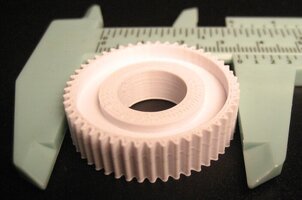
This is the 49-tooth version that I quickly printed last night, from an enhanced version of that OpenSCAD script I posted earlier:

HVAC-actuator-gear-from-3D-printer.jpg

Even with no tweaks to the layer height or lowering of print speed (or any other techniques meant to improve quality/resolution), it came out better than I expected! I will definitely be pursuing this option if any of these actuator gears fail in the future.
 
It's a little hard to tell from the photo but it appears to be what I would describe as 'moderate' resolution; if you used default settings and have room for improvement you may have something really workable for the application. How accurate were the dimensions? One of my concerns would be the I.D. as it needs to be a press fit on the metal hub (unless you use a technique similar to my roll pin to lock it down). I noticed on the metal hubs that they had two small flats which you could incorporate into your design, that way you wouldn't have to be so finicky about the final dimension, in fact you could even make it a slip fit so that there wouldn't be any imposed stress on the gear that might lead to the original problem again.

How do you like using OpenSCAD? First time I've heard of it, I'm only 3 years into retirement and I'm already losing ground! From what I could tell at first glance it's a script based interface rather than 'visual' or 'graphic' as something like Solidworks. Looks to be pretty easy to use but someone like me being steeped in Solidworks it might be challenging. And the BOSL2 I would describe as a 'plug-in' of sorts that handles the more intense requirements of gear design, correct? So yeah, it looks to be pretty simple to make minor changes and then 'waste' another 12 cents to check your work. So there must be other plug-ins that handle other specialized tasks?
 
It's a little hard to tell from the photo
Sorry for the low-res photo. I shrunk it to keep the uploaded file size manageable.

It's certainly not a perfect gear, but there are many things I could do to try to improve it, including some I didn't even mention yet, like enabling "random seams". And, for the record, I did no cleanup whatsoever on the teeth -- it came off the printer just as you see it.

Now, to be clear, this was printed with PLA filament. I would not use that in a real gear that was subject to the interior temperatures in a vehicle (especially in Arizona!). So were I to do this "for real", I'd want to print it in something that could better stand up to the heat (maybe PETG or ABS -- I'm not really sure there). And I'd need to re-calibrate and tweak the print settings a bit for the new filament type. So, for now, this is all an exercise in "possibilities".

How accurate were the dimensions?
I think it was quite good, but my standards might be (far?) lower than someone with a background in machining (etc). I substituted my digital, metal calipers for the plastic ones in the photo and took some measurements. The shaft hole, which should be 14.0 mm is 13.8 mm (1.4% off). For a part like this, that seems "good enough" to me, but of course, even if it's not, the beauty of 3D modeling & printing this way is the ease of tweaking the model and re-printing. But again, it's getting a bit ahead of the game unless I'm printing with the appropriate filament type.

Also, I didn't put any effort into getting the actual overall gear diameter precise because there's no point until I have an actual gear to replicate. I didn't even bother trying to get the diameter exact as compared to the 3D model I linked to. I just set that "circ_pitch" value in the "spur_gear" routine to make it come out reasonably close to the linked model.

Generally speaking, if something is not printing with adequate dimensional accuracy, it's a hint that the printer should be re-calibrated. I've never bothered to do any dimensional calibration, but I know how to do so if it's needed.

One of my concerns would be the I.D. as it needs to be a press fit on the metal hub (unless you use a technique similar to my roll pin to lock it down). I noticed on the metal hubs that they had two small flats which you could incorporate into your design, that way you wouldn't have to be so finicky about the final dimension, in fact you could even make it a slip fit so that there wouldn't be any imposed stress on the gear that might lead to the original problem again.
Oh, yes, I think I see the flats in your photos! It looks like the original gear didn't accommodate them because I see what looks like a gap there, in your "vise" shot.

So, in other words, eliminate the "interference fit" (or, I guess some would say, "press fit") currently used by that splined shaft and utilize a gear with a slightly larger inner diameter, but with cutouts to accommodate the flats on the metal drive hub? Yes, I could easily (well, given a bit of time, given my inexperience!) add a couple of flat spots inside the gear shaft hole.

But, assuming I've understood you correctly, I wonder if the additional flexibility of movement might aggravate the gear mating? Of course, if I were to design something "for real", I'd experiment a bit to get the sizing "just right", on all dimensions.

How do you like using OpenSCAD?
I like it a lot, but I'm very comfortable with programming (in various venues). I've only dabbled very briefly with the more "conventional" FreeCAD program. I find myself using OpenSCAD for virtually everything simply because I can keep the design overtly parametric, even in cases where it's not strictly needed.

From what I could tell at first glance it's a script based interface rather than 'visual' or 'graphic' as something like Solidworks.
Yes, but there is immediate visual feedback of your script/program changes. You just don't "freehand" the design like one would in a typical CAD program. OpenSCAD is great for repeatability and for flexibility of certain design changes. Even so, even for me, it takes some getting used to, especially since I don't use it on a regular basis.

Looks to be pretty easy to use but someone like me being steeped in Solidworks it might be challenging.
I know that a lot of folks who come from a conventional CAD background and tools often hate OpenSCAD. It's a different way of thinking about CAD, to be sure. But, as I learned 1st-hand yesterday, it's quite flexible with add-on libraries like BOSL2. I feel that BOSL2 will open up a lot of exploration for me in the coming months/years.

And the BOSL2 I would describe as a 'plug-in' of sorts that handles the more intense requirements of gear design, correct?
Yes -- gear design and much more!

So there must be other plug-ins that handle other specialized tasks?
Yes, I just haven't had time to explore it all. BOSL/BOSL2 is one that's mentioned a lot and, having just now experienced it, I can see why.
 
To Echo the efforts and design memorialized here by the OP... This Fellow included using some Epoxy (and later on...some JB-Weld for the Pot-Metal Axle) and much more laboriously followed the similar pattern doing what Dentists used to call "The Pin-Resin Technique":

CRACKEDBDAGEAR.jpg

From 4:38... Forward... The Gear Timing Instructions are SWEET!

 
Last edited:

Forum Statistics

Threads
24,247
Posts
648,393
Members
20,684
Latest member
goneracin

Members Online