

You are using an out of date browser. It may not display this or other websites correctly.
You should upgrade or use an alternative browser.
You should upgrade or use an alternative browser.
Manual temp gauge install
- Thread starter atron-ward
- Start date

You might have to drill and tap a threaded hole in something like the thermostat housing. Lots of work, since there's already a temp sensor there.
Why not get a scan tool or Scangauge and read the data stream that's already available from the PCM using existing sensors? Many, many more useful functions available if you have your own scan tool.
Why not get a scan tool or Scangauge and read the data stream that's already available from the PCM using existing sensors? Many, many more useful functions available if you have your own scan tool.


A lot of people just cut the radiator hose and add a t type adapter with a sending unit in it and then hook it up to a gauge...
http://www.glowshiftdirect.com/Water-Hose-Adapters.aspx
http://www.glowshiftdirect.com/Water-Hose-Adapters.aspx
Boricua SS said:A lot of people just cut the radiator hose and add a t type adapter with a sending unit in it and then hook it up to a gauge...
Water Temperature Sender Attachments
i cant trust the oil gauge its a complet lie so what else is a lie on this dash. i just got done running a mechanical oil gauge and it reades as follow 50 psi at idle and goes up from there. thanks iam going to look for somthing like a break in

It wouldn't be that hard to drill and tap into the top water outlet for a sensor. I did it for my efan controller sensor. And yes, you would use the top hose as the water circulates out of the engine through the top hose to the radiator.
Mooseman said:It wouldn't be that hard to drill and tap into the top water outlet for a sensor. I did it for my efan controller sensor. And yes, you would use the top hose as the water circulates out of the engine through the top hose to the radiator.
Thanks for the ideas I looked at the sight with the in line adapter for sensor. That a great idea. Has any one test the temp gauge to see how accurate it is to motor temp. I guess its more important than oil.
The temp gauge also lies, but it's a smaller lie than the oil pressure. The PCM filters and averages the "real" temp (that you can obtain with a scan tool) so the needle doesn't appear to move away from straight-up-12-o'clock under normal driving conditions, when the truth is that is varies from 190-220 or so.
the roadie said:The temp gauge also lies, but it's a smaller lie than the oil pressure. The PCM filters and averages the "real" temp (that you can obtain with a scan tool) so the needle doesn't appear to move away from straight-up-12-o'clock under normal driving conditions, when the truth is that is varies from 190-220 or so.
Thanks I was figuring that out. That's why iam ordering the in line t adapter. This is the **** I am talking about gm and all the other manufacturer engineering this **** .
Thanks a lot

View attachment 30315
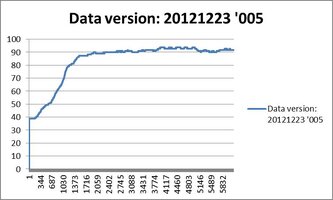
I got this from tapping the data.
you do not need to insert another sensor to get the real data, just have to read from the computer via the OBD port.
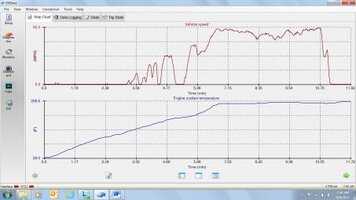
next one is from my TDI, in centigrade,
in both cases, when you get close, the display on the dash remains steady.
you may want to check out these:
ScanGauge - Trip Computer + Digitial Gauges + ScanTools
what would you use for display after you insert additional sensors?
I got this from tapping the data.
you do not need to insert another sensor to get the real data, just have to read from the computer via the OBD port.
next one is from my TDI, in centigrade,
in both cases, when you get close, the display on the dash remains steady.
you may want to check out these:
ScanGauge - Trip Computer + Digitial Gauges + ScanTools
what would you use for display after you insert additional sensors?
Attachments
meerschm said:View attachment 17100
I got this from tapping the data.
you do not need to insert another sensor to get the real data, just have to read from the computer via the OBD port.
next one is from my TDI, in centigrade,
in both cases, when you get close, the display on the dash remains steady.
you may want to check out these:
ScanGauge - Trip Computer + Digitial Gauges + ScanTools
what would you use for display after you insert additional sensors?
I have mechanical temp probe like u use in the old school cars
I've compared my dash temp gauge and actual sensor temp from my ELM327 via Torque and it is pretty bang-on. The only thing though is that it changes only in steps (hence stepper motor). In my case, I think it moves in 5°C increments. Since I have efans, I see it move on a regular basis. It may be different for later years but I trust mine. My 08 Montana NEVER moves from the middle. Heck, it doesn't even have numbers.
Dip the mechanical probe into a pot of boiling water. If it doesn't display 212, you're back to square one.
If your probe is just a bare cylinder, you can buy "thermocouple" fittings that will adapt the probe to the insertion point. They're nice because the probe can slide right through the fitting to achieve any probe depth needed.
You can also make thermocouple fittings from some basic tube fittings, like Swagelok. Just drill 'em out.
FWIW- Swagelok has one of the finest machining centers in the USA.
If your probe is just a bare cylinder, you can buy "thermocouple" fittings that will adapt the probe to the insertion point. They're nice because the probe can slide right through the fitting to achieve any probe depth needed.
You can also make thermocouple fittings from some basic tube fittings, like Swagelok. Just drill 'em out.
FWIW- Swagelok has one of the finest machining centers in the USA.